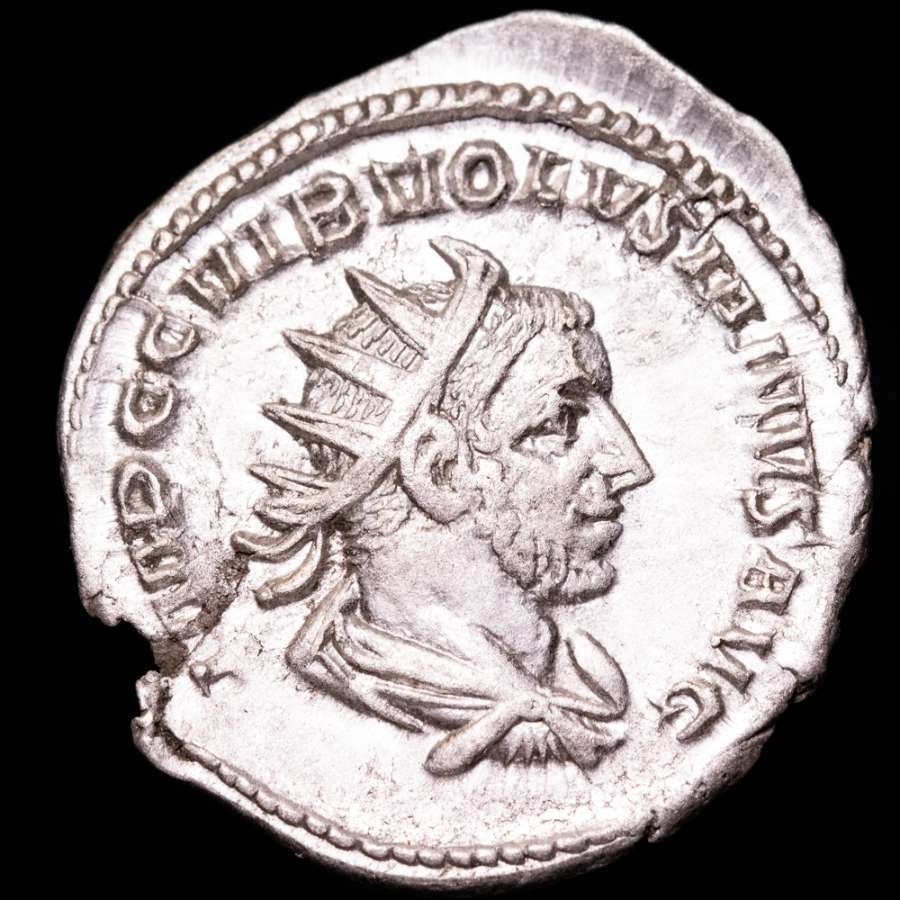
Obverse
Anverso
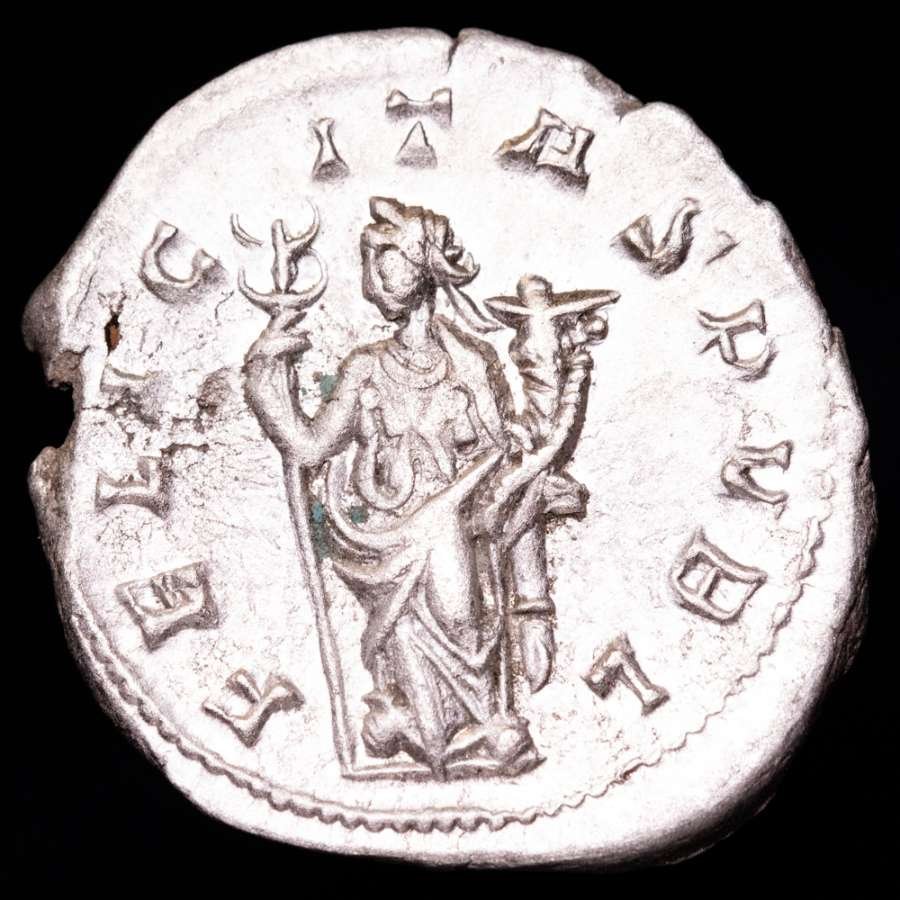
Reverse
Reverso
A silver antoninianus of Volusian (C. Vibius Afinius Gallus Veldumnianus Volusianus), struck during his reign as Augustus, attributed to the Rome mint. The obverse carries the radiate, draped and cuirassed bust of the emperor with the legend IMP C C VIB VOLVSIANVS AVG. The reverse depicts Felicitas, the personification of prosperity and public well-being, standing left and holding a long caduceus and a cornucopia, with the legend FELICITAS PVBL.
Personifications such as Felicitas appear frequently in Roman imperial coinage of this period, generally associated with messages of prosperity, stability and good fortune for the state. The type is catalogued as RIC IV 205 and RSC 32; published parallels for this reference are also recorded with an attribution to the Mediolanum (Milan) mint, and the specific mint of this example has not been independently confirmed.
Um antoninianus de prata de Volusiano (C. Vibius Afinius Gallus Veldumnianus Volusianus), cunhado durante o seu reinado como Augusto, atribuído à casa da moeda de Roma. O anverso apresenta o busto radiado, drapeado e couraçado do imperador com a legenda IMP C C VIB VOLVSIANVS AVG. O reverso representa Felicitas, personificação da prosperidade e do bem-estar público, em pé voltada para a esquerda, segurando um caduceu longo e uma cornucópia, com a legenda FELICITAS PVBL.
Personificações como Felicitas surgem frequentemente na cunhagem imperial romana deste período, geralmente associadas a mensagens de prosperidade, estabilidade e boa fortuna para o Estado. O tipo está catalogado como RIC IV 205 e RSC 32; paralelos publicados para esta referência encontram-se também registados com atribuição à casa da moeda de Mediolanum (Milão), e a casa da moeda específica deste exemplar não foi confirmada de forma independente.
Volusian reigned between 251 and 253 AD, initially associated with his father, the emperor Trebonianus Gallus, as co-Augustus. His brief reign occurred during the so-called Crisis of the Third Century, a period characterised by political instability, military conflict, frequent changes of power and economic strain across the Roman Empire.
The reign of Trebonianus Gallus and Volusian ended in 253 AD when both were killed, reportedly by their own troops, amid the usurpation of Aemilianus. Coinage of this period frequently emphasises themes of stability, prosperity and continuity — such as the Felicitas type seen here — at a time when the Roman state faced considerable internal and external pressure.
Volusiano reinou entre 251 e 253 d.C., inicialmente associado ao seu pai, o imperador Treboniano Galo, como co-Augusto. O seu curto reinado ocorreu durante a chamada Crise do Século III, um período caracterizado por instabilidade política, conflitos militares, frequentes mudanças de poder e pressão económica em todo o Império Romano.
O reinado de Treboniano Galo e Volusiano terminou em 253 d.C., quando ambos foram mortos, segundo relatos pelas suas próprias tropas, no contexto da usurpação de Emiliano. A moedagem deste período enfatiza frequentemente temas de estabilidade, prosperidade e continuidade — como o tipo Felicitas aqui presente — numa época em que o Estado romano enfrentava considerável pressão interna e externa.
The example preserves much of the detail of the imperial portrait and the figure of Felicitas. Small losses and irregularities are visible at the edge, consistent with normal circulation and preservation of Roman coins of this period.
O exemplar preserva grande parte dos detalhes do retrato imperial e da figura de Felicitas. São visíveis pequenas perdas e irregularidades no bordo, compatíveis com a circulação e preservação normal de moedas romanas deste período.