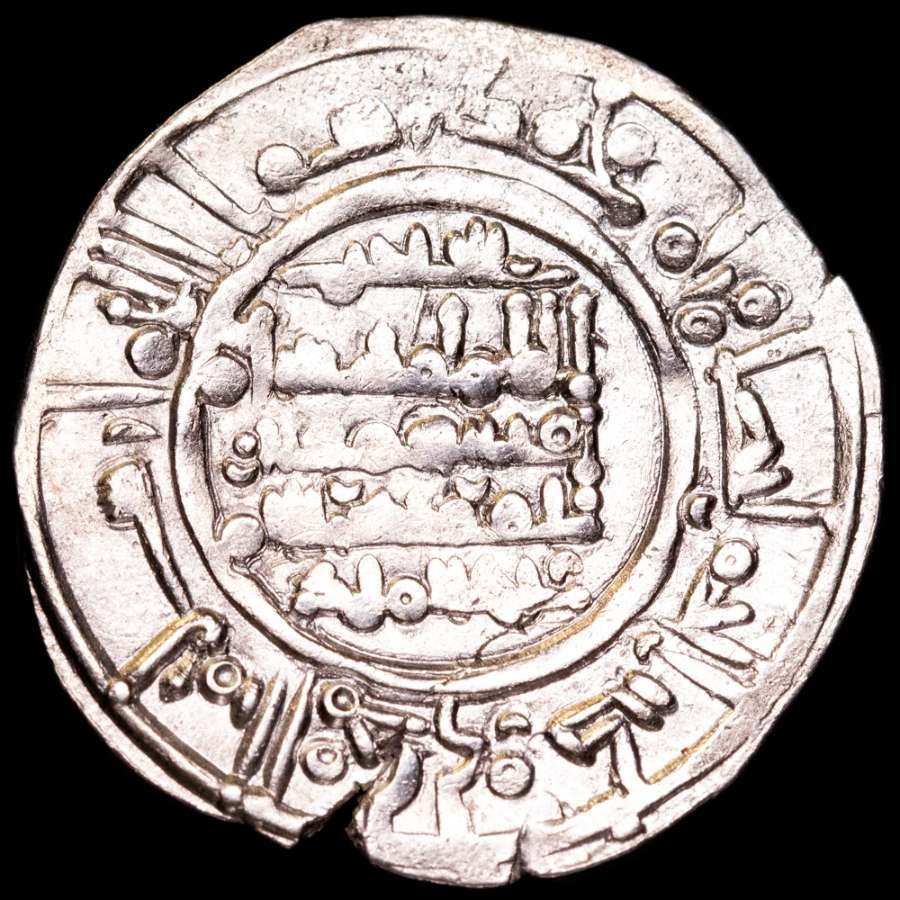
Side A
Lado A
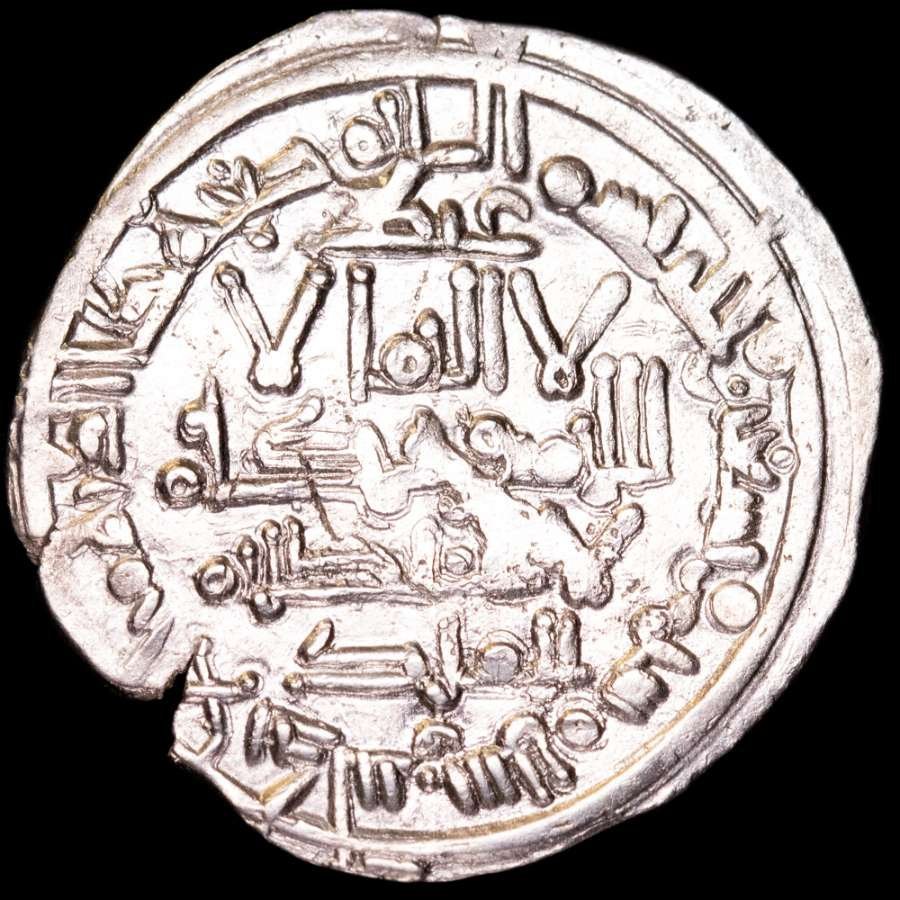
Side B
Lado B
A silver dirham issued in the name of caliph Hisham II (al-Hakam al-Mu'ayyad bi-llah), struck at Al-Andalus in the year 396 of the Hegira (1005–1006 AD). The example carries Kufic inscriptions distributed between the central field and marginal legends, following the characteristic model of Umayyad coinage of Al-Andalus. The inscriptions identify the caliph Hisham II and include reference to ʿAbd al-Malik al-Muzaffar, the principal political authority of the Caliphate during this period.
As with the majority of medieval Islamic coinage, the coin is entirely epigraphic, without figurative representation. Classification of dirhams of this type rests primarily on the inscriptions, which record the issuing authority, the date and the mint.
Um dirham de prata emitido em nome do califa Hixame II (al-Hakam al-Mu'ayyad bi-llah), cunhado em Al-Andalus no ano 396 da Hégira (1005–1006 d.C.). O exemplar apresenta inscrições cúficas distribuídas entre o campo central e as legendas marginais, seguindo o modelo característico da cunhagem omíada de Al-Andalus. As inscrições identificam o califa Hixame II e incluem referência a ʿAbd al-Malik al-Muzaffar, a principal autoridade política do Califado durante este período.
Tal como a maioria da cunhagem islâmica medieval, a moeda é integralmente epigráfica, sem representação figurativa. A classificação de dirhams deste tipo baseia-se principalmente nas inscrições, que registam a autoridade emissora, a data e o local de cunhagem.
Hisham II was caliph of Córdoba between 976 and 1009 AD, though much of the political power during his reign was exercised by a succession of different hajib (chamberlains, or chief ministers), who governed in his name. This dirham was issued during the administration of ʿAbd al-Malik al-Muzaffar (1002–1008 AD), son and successor of Almanzor (al-Mansur ibn Abi Amir), in a late phase of the history of the Caliphate of Córdoba.
The Caliphate of Córdoba reached its greatest territorial and cultural extent under Abd al-Rahman III and al-Hakam II in the 10th century, before entering a period of internal instability in the early 11th century that would eventually lead to its fragmentation into the taifa kingdoms. Dirhams of the Caliphate of Córdoba are important documentary sources for this period, as the inscriptions record the names of caliphs and chamberlains, allowing precise dating and attribution.
Hixame II foi califa de Córdova entre 976 e 1009 d.C., embora grande parte do poder político durante o seu reinado tenha sido exercido por uma sucessão de diferentes hajib (camareiros, ou primeiros ministros), que governavam em seu nome. Este dirham foi emitido durante a administração de ʿAbd al-Malik al-Muzaffar (1002–1008 d.C.), filho e sucessor de Almançor (al-Mansur ibn Abi Amir), numa fase tardia da história do Califado de Córdova.
O Califado de Córdova atingiu a sua maior extensão territorial e cultural sob Abd al-Rahman III e al-Hakam II no século X, antes de entrar num período de instabilidade interna no início do século XI que conduziria, eventualmente, à sua fragmentação em reinos de taifas. Os dirhams do Califado de Córdova constituem importantes fontes documentais para este período, uma vez que as inscrições registam os nomes dos califas e camareiros, permitindo uma datação e atribuição precisas.
The example preserves the central and marginal inscriptions clearly, including the date and references to the issuing authorities. Small losses at the edge are consistent with the normal circulation and preservation of coins of this period.
O exemplar conserva de forma clara as inscrições centrais e marginais, incluindo a data e as referências às autoridades emissoras. Pequenas falhas no bordo são compatíveis com a circulação e preservação normal de moedas deste período.