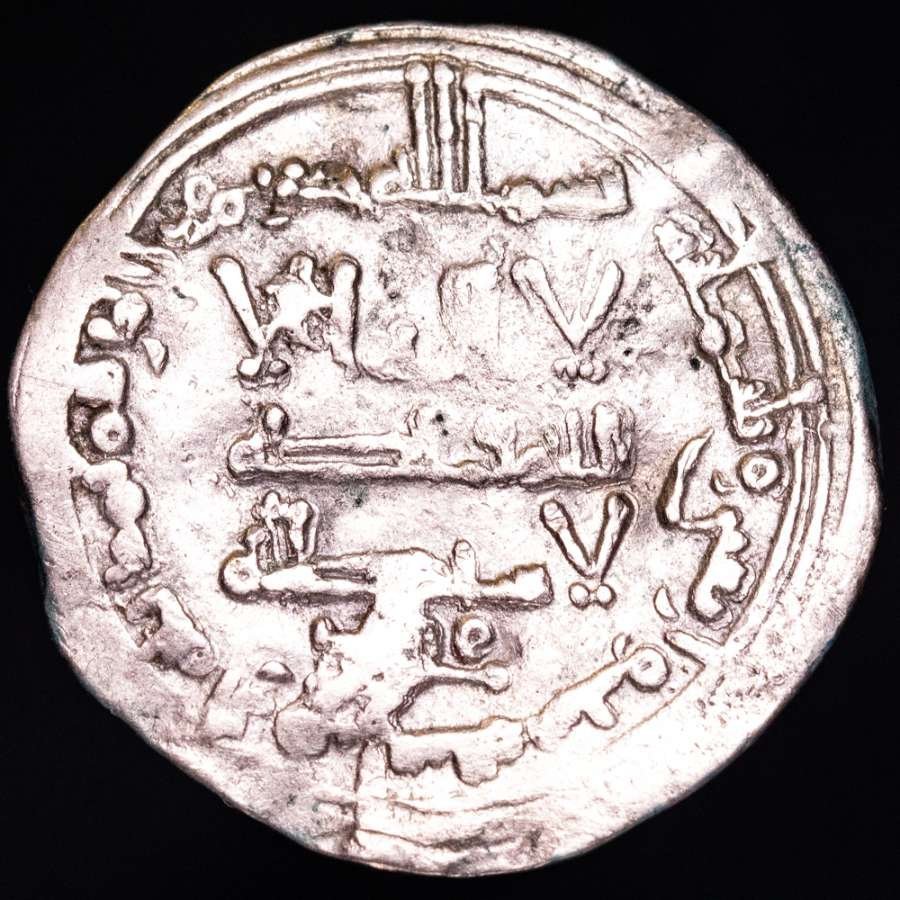
Side A
Lado A
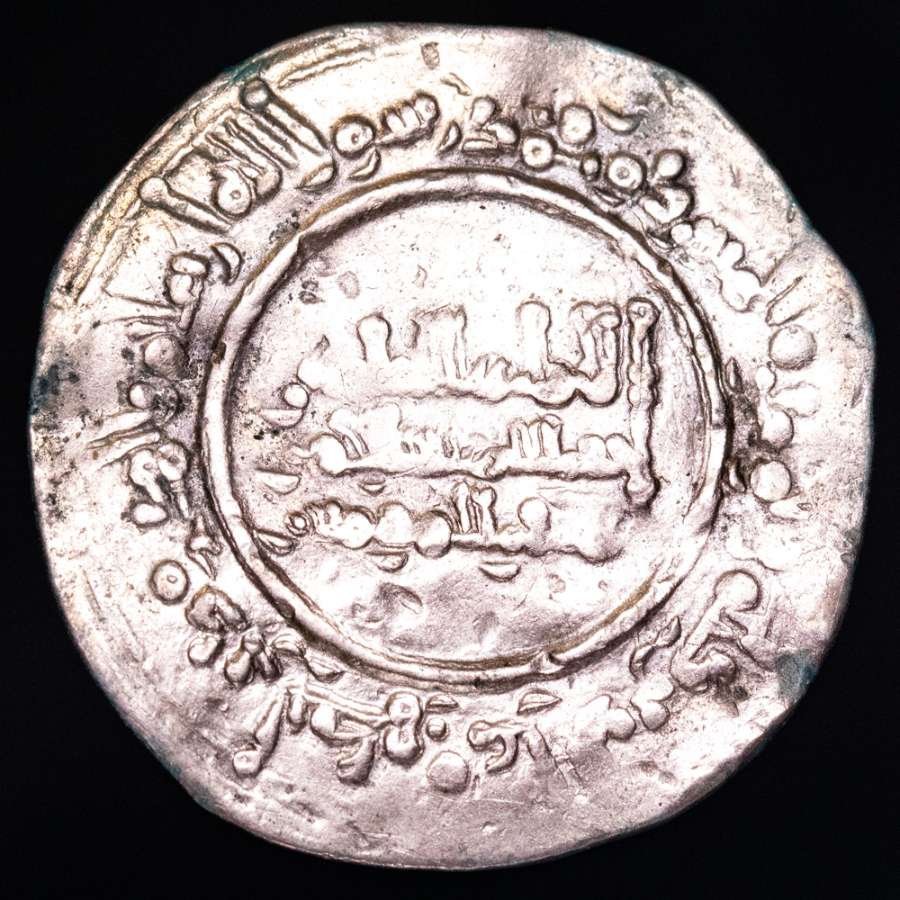
Side B
Lado B
A silver dirham issued in the name of caliph Abd al-Rahman III al-Nasir li-Din Allah (r. 929–961 AD), struck at Madinat al-Zahra in the year 346 of the Hegira (957–958 AD). The example carries Kufic inscriptions distributed between the central field and marginal legends, following the characteristic model of Umayyad coinage of Al-Andalus. Among the inscriptions is a reference to Muhammad, identified in numismatic classification as the official named in the inner field of the obverse.
As with the majority of medieval Islamic coinage, the coin is entirely epigraphic, without figurative representation. Unlike issues from the generic Al-Andalus mint, the marginal legend on this example explicitly names Madinat al-Zahra, allowing a confident mint attribution.
Um dirham de prata emitido em nome do califa Abd al-Rahman III al-Nasir li-Din Allah (r. 929–961 d.C.), cunhado em Madinat al-Zahra no ano 346 da Hégira (957–958 d.C.). O exemplar apresenta inscrições cúficas distribuídas entre o campo central e as legendas marginais, seguindo o modelo característico da cunhagem omíada de Al-Andalus. Entre as inscrições encontra-se uma referência a Muhammad, identificado na classificação numismática como o responsável mencionado no campo interno do anverso.
Tal como a maioria da cunhagem islâmica medieval, a moeda é integralmente epigráfica, sem representação figurativa. Ao contrário de emissões da ceca genérica de Al-Andalus, a legenda marginal deste exemplar indica explicitamente Madinat al-Zahra, permitindo uma atribuição de casa da moeda segura.
Abd al-Rahman III proclaimed himself caliph in 929 AD, establishing the Caliphate of Córdoba and consolidating Umayyad authority on the Iberian Peninsula. His reign represents the political and territorial apex of Umayyad rule in Al-Andalus, prior to the later instability that affected the Caliphate under his successors.
This dirham was struck at Madinat al-Zahra, the palatine city founded by Abd al-Rahman III on the outskirts of Córdoba. Construction began in 936 AD, and Madinat al-Zahra became an important administrative and political centre of the Caliphate during the 10th century. Coin issues from Madinat al-Zahra are direct material evidence of this period of political consolidation and prosperity of the Umayyad state in Al-Andalus.
Abd al-Rahman III proclamou-se califa em 929 d.C., estabelecendo o Califado de Córdova e consolidando a autoridade omíada na Península Ibérica. O seu reinado representa o auge político e territorial do domínio omíada em Al-Andalus, antes da instabilidade posterior que afectaria o Califado sob os seus sucessores.
Este dirham foi cunhado em Madinat al-Zahra, a cidade palatina fundada por Abd al-Rahman III nos arredores de Córdova. A construção iniciou-se em 936 d.C., e Madinat al-Zahra tornou-se um importante centro administrativo e político do Califado durante o século X. As emissões monetárias provenientes de Madinat al-Zahra constituem testemunhos materiais directos deste período de consolidação política e prosperidade do estado omíada de Al-Andalus.
The central and marginal inscriptions remain largely legible, including the date and the mint designation. The example shows wear consistent with circulation, while preserving the principal elements used for its identification and classification.
As inscrições centrais e marginais permanecem amplamente legíveis, incluindo a data e a indicação da casa da moeda. O exemplar apresenta desgaste compatível com circulação, preservando contudo os principais elementos utilizados para a sua identificação e classificação.