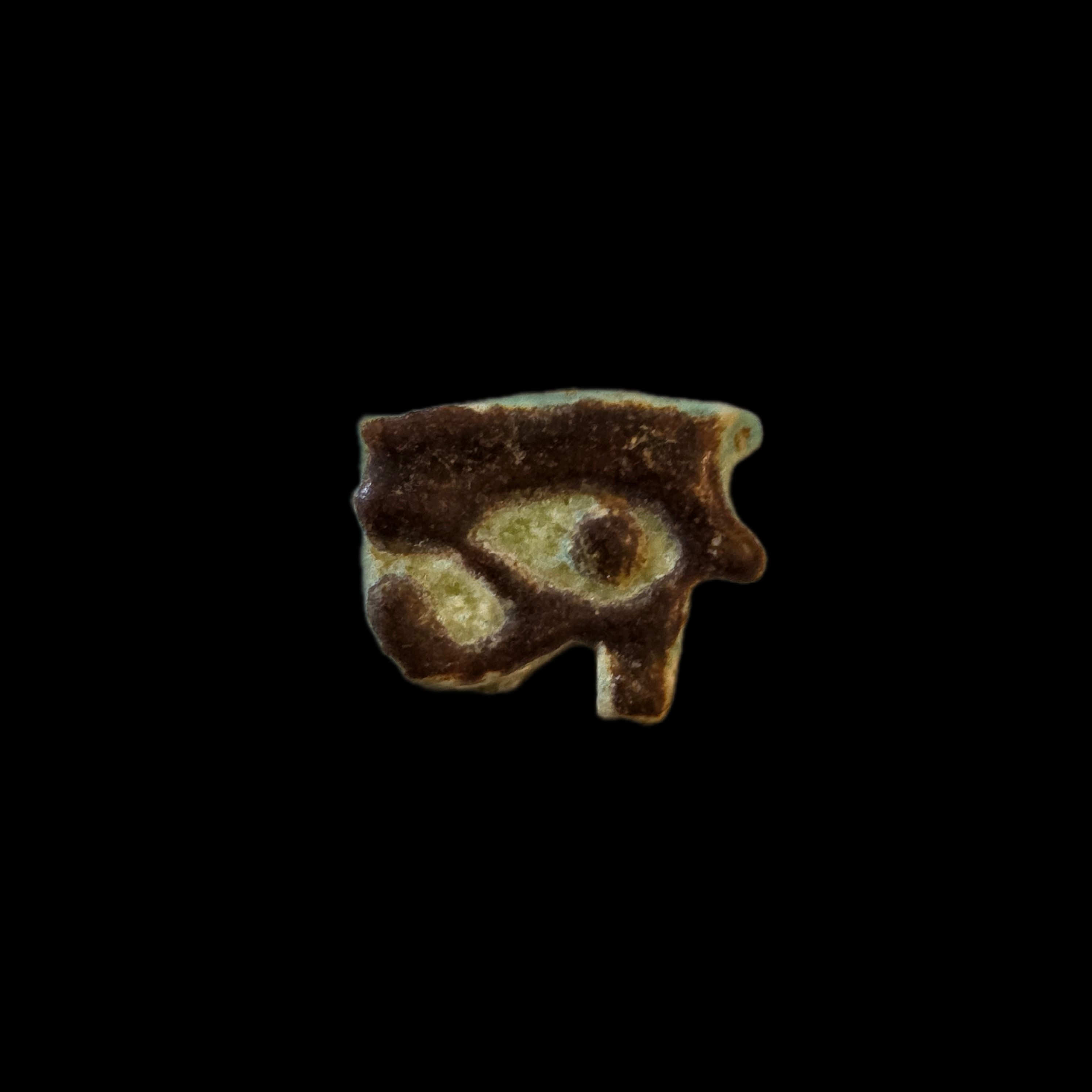
Small faience amulet representing the Eye of Horus (Wedjat). The piece is moulded in low relief and preserves dark painted details on one face, highlighting the principal features of the eye.
The amulet displays the characteristic stylised form of the Wedjat, including the characteristic markings associated with the stylised representation of the divine eye. A perforation indicates that it was intended to be suspended or worn.
Traces of painted decoration survive on one face, a feature not always preserved on comparable faience amulets.
Pequeno amuleto em faiança representando o Olho de Hórus (Wedjat). A peça é moldada em baixo-relevo e preserva detalhes pintados em tom escuro numa face, destacando os principais elementos do olho.
O amuleto apresenta a forma estilizada característica do Wedjat, incluindo as marcações características associadas à representação estilizada do olho divino. Uma perfuração indica que se destinava a ser suspenso ou usado.
Sobrevivem vestígios de decoração pintada numa face, uma característica nem sempre preservada em amuletos comparáveis em faiança.
The Eye of Horus, known in ancient Egypt as the Wedjat, was among the most widespread protective symbols in Egyptian material culture. It was commonly worn as a personal amulet and was also deposited in funerary contexts.
The symbol was associated with protection, healing and restoration, deriving from the myth in which the eye of Horus was injured and subsequently restored.
Faience Wedjat amulets were especially common during the Late Period and Ptolemaic Period, although the motif remained popular throughout much of the first millennium BC.
O Olho de Hórus, conhecido no Egito Antigo como Wedjat, foi um dos símbolos protectores mais difundidos na cultura material egípcia. Era frequentemente usado como amuleto pessoal e também depositado em contextos funerários.
O símbolo estava associado à protecção, cura e restauração, derivando do mito em que o olho de Hórus foi ferido e posteriormente restaurado.
Os amuletos Wedjat em faiança eram especialmente comuns durante o Período Tardio e o Período Ptolemaico, embora o motivo se tenha mantido popular ao longo de boa parte do primeiro milénio a.C.
Comparable faience Wedjat amulets are represented in numerous museum collections, including the British Museum and the Metropolitan Museum of Art, reflecting the widespread use of this protective symbol throughout Ancient Egyptian history.
Amuletos Wedjat comparáveis em faiança encontram-se representados em numerosas coleções museológicas, incluindo o British Museum e o Metropolitan Museum of Art, refletindo a ampla utilização deste símbolo protector ao longo da história do Egito Antigo.