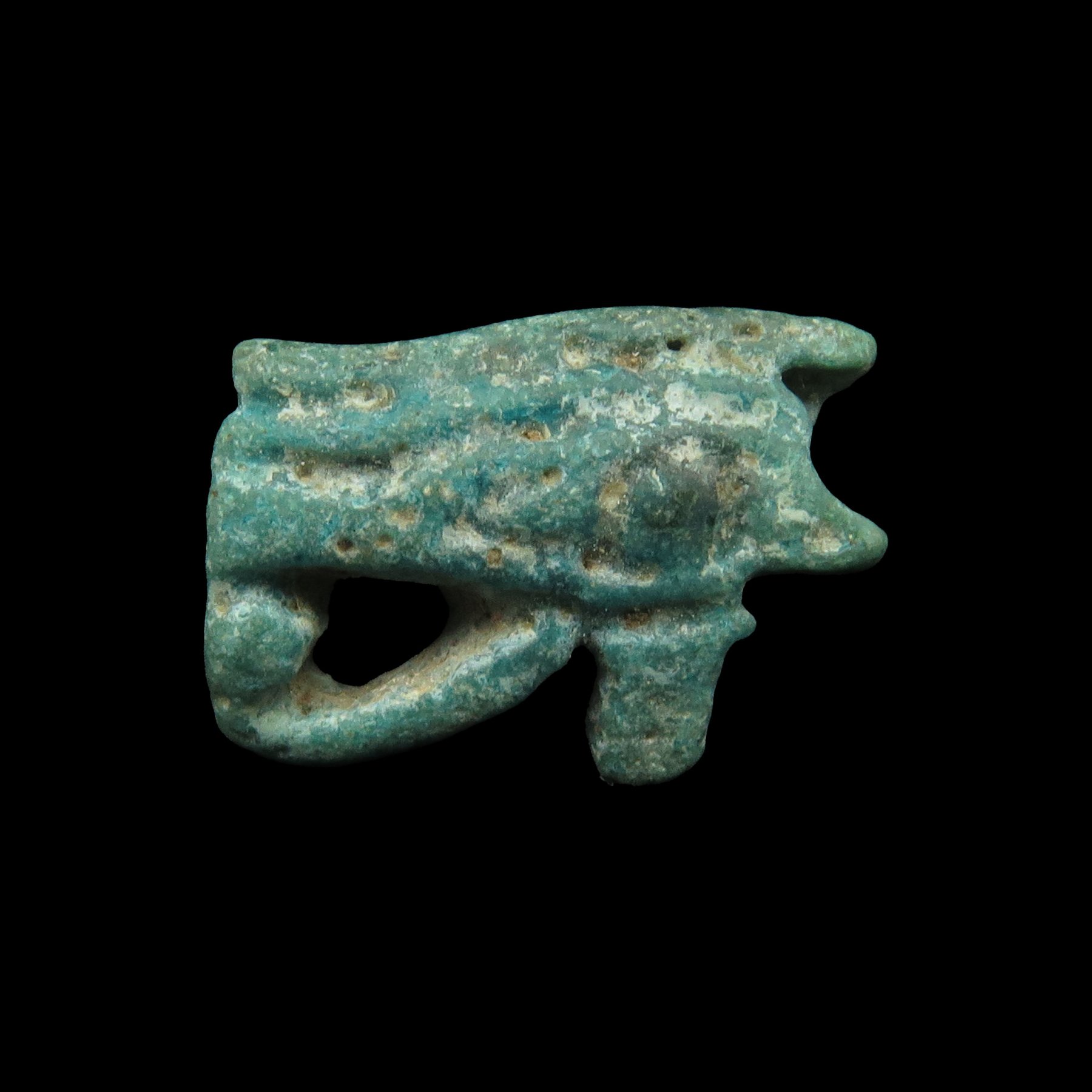
A well-preserved faience amulet in the form of the Wedjat — the Eye of Horus — in a vivid turquoise-blue glaze characteristic of Late Period workshop production. The piece is modelled in the round with articulated anatomical elements: the eyeball with pupil, the distinctive cosmetic extension (the teardrop line below), and the falcon markings that flank and frame the eye above. Despite its small size (1.8 cm), the modelling is confident and retains excellent glaze coverage.
The reverse is flat and undecorated. A suspension loop or horizontal piercing would have allowed the amulet to be worn on a cord or sewn onto linen wrappings — the Wedjat was among the most commonly placed amulets in Egyptian mummy burials, positioned over the embalming incision on the left side of the body to protect and heal.
Um amuleto em faiança bem preservado na forma do Wedjat — o Olho de Hórus — num esmalte azul-turquesa vivo, característico da produção das oficinas do Período Tardio. A peça é modelada em bulto redondo com elementos anatómicos articulados: o globo ocular com pupila, a extensão cosmética distintiva (a linha em gota abaixo), e as marcas de falcão que flanqueiam e enquadram o olho acima. Apesar das suas pequenas dimensões (1,8 cm), a modelação é segura e conserva excelente cobertura de esmalte.
O reverso é plano e sem decoração. Um anel de suspensão ou perfuração horizontal teria permitido que o amuleto fosse usado num cordão ou cosido sobre as ataduras de linho — o Wedjat estava entre os amuletos mais frequentemente colocados nos enterros de múmias egípcias, posicionado sobre a incisão de embalsamamento no lado esquerdo do corpo para proteger e curar.
The Wedjat — meaning "the whole one" or "the sound eye" — is one of the most widespread protective symbols of ancient Egypt, representing protection, royal power, and good health. According to myth, the eye of Horus was torn out and scattered by his uncle Seth during their cosmic battle, then magically restored by Thoth. The healed eye became a symbol of restoration, sacrifice, and divine protection.
In Egyptian religious thought, solar and lunar eye symbolism could overlap, and Wedjat imagery acquired both protective and restorative associations. Mathematically, the six components of the Wedjat were used by ancient Egyptian scribes to represent fractions, each part corresponding to a fraction of the heqat — a unit of grain measure.
Wedjat amulets were produced throughout Egyptian history but reached peak production during the Late Period, when they were placed on mummies, worn by the living, and deposited in tombs in enormous numbers. This example, with its vivid surviving glaze and clear modelling, is consistent with Late Period faience workshop production.
O Wedjat — significando "o inteiro" ou "o olho são" — é um dos símbolos protectores mais difundidos do Egito Antigo, representando protecção, poder real e boa saúde. Segundo o mito, o olho de Hórus foi arrancado e espalhado pelo seu tio Seth durante a sua batalha cósmica, depois magicamente restaurado por Tot. O olho curado tornou-se símbolo de restauração, sacrifício e protecção divina.
O simbolismo solar e lunar do olho podia sobrepor-se no pensamento religioso egípcio, conferindo ao Wedjat associações protectoras e restauradoras. Matematicamente, os seis componentes do Wedjat eram usados pelos escribas egípcios para representar fracções, cada parte correspondendo a uma fracção do heqat — uma unidade de medida de grão.
Os amuletos Wedjat foram produzidos ao longo da história egípcia mas atingiram o pico de produção durante o Período Tardio, quando eram colocados em múmias, usados pelos vivos e depositados em tumbas em números enormes. Este exemplar, com o seu esmalte vivo preservado e modelação clara, é um exemplar bem preservado da arte da faiança do Período Tardio.
A comparable Wedjat amulet of the same type, period and material is held in the permanent collection of the Metropolitan Museum of Art, New York.
Um amuleto Wedjat comparável do mesmo tipo, período e material encontra-se na colecção permanente do Metropolitan Museum of Art, Nova Iorque.