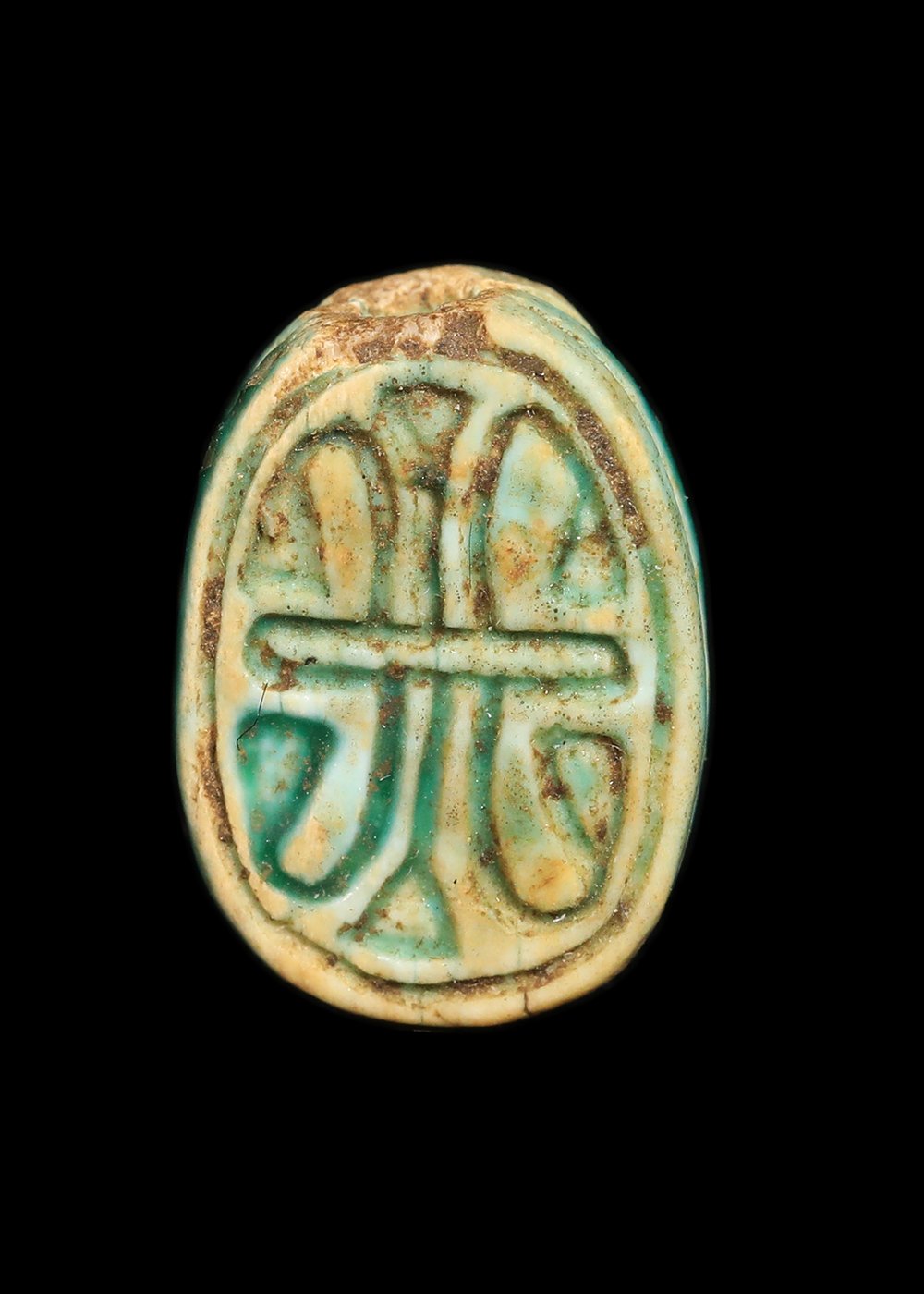
A well-preserved New Kingdom faience scarab with a vivid blue glaze. The piece is modelled in the round with a naturalistically formed dorsal surface showing the head, prothorax and divided elytra typical of Egyptian scarab production. The base is decorated with a carefully incised composition of paired papyrus plants, a motif of considerable symbolic significance.
The scarab beetle was one of the most ubiquitous symbols in ancient Egyptian art and religion, associated with the solar god Ra and the concept of daily renewal. The Egyptians observed the dung beetle rolling its ball across the sand and interpreted this as a mirror of the sun's journey across the sky — from sunrise to sunset, from life to death and back to rebirth. As the beetle laid its eggs within the dung ball, it became a symbol of self-creation and regeneration.
Um escaravelho em faiança do Novo Império bem preservado, com um esmalte azul vivo. A peça é modelada em bulto redondo com uma superfície dorsal naturalista mostrando a cabeça, o pronoto e os élitros divididos, típicos da produção egípcia de escaravelhos. A base está decorada com uma composição cuidadosamente incisa de plantas de papiro emparelhadas, um motivo de considerável significado simbólico.
O escaravelho era um dos símbolos mais omnipresentes na arte e religião do Egito Antigo, associado ao deus solar Rá e ao conceito de renovação diária. Os egípcios observavam o escaravelho a rolar a sua bola de estrume pela areia e interpretavam isto como um espelho da jornada do sol pelo céu — do nascer ao pôr do sol, da vida à morte e de volta ao renascimento. À medida que o escaravelho depositava os seus ovos na bola de estrume, tornou-se símbolo de auto-criação e regeneração.
The papyrus plant was one of the most important symbols in Egyptian culture, representing Lower Egypt and the fertile Nile Delta. As the heraldic plant of the north, it was frequently paired with the lotus of Upper Egypt in compositions symbolising the unification of the Two Lands under pharaonic rule. On scarab bases, papyrus motifs may have carried associations with regeneration, fertility and Lower Egypt — they invoked the regenerative power of the Nile flood and the abundance associated with the Delta marshes where the young Horus was hidden and protected by Isis.
The combination of the scarab (solar rebirth) with the papyrus (Nilotic fertility and Lower Egypt) on a single small amulet is commonly interpreted as combining solar and fertility symbolism, though the specific meaning of individual design choices cannot be established with certainty.
A planta de papiro era um dos símbolos mais importantes da cultura egípcia, representando o Baixo Egito e o fértil Delta do Nilo. Como planta heráldica do norte, era frequentemente emparelhada com o lótus do Alto Egito em composições que simbolizavam a unificação das Duas Terras sob o domínio faraónico. Nas bases dos escaravelhos, os motivos de papiro poderão ter tido associações com regeneração, fertilidade e o Baixo Egito — invocavam o poder regenerador da inundação do Nilo e a abundância associada aos pântanos do Delta onde o jovem Hórus foi escondido e protegido por Ísis.
A combinação do escaravelho (renascimento solar) com o papiro (fertilidade nilótica e Baixo Egito) num único pequeno amuleto é comummente interpretada como combinando simbolismo solar e de fertilidade, embora o significado específico de escolhas de design individuais não possa ser estabelecido com certeza.