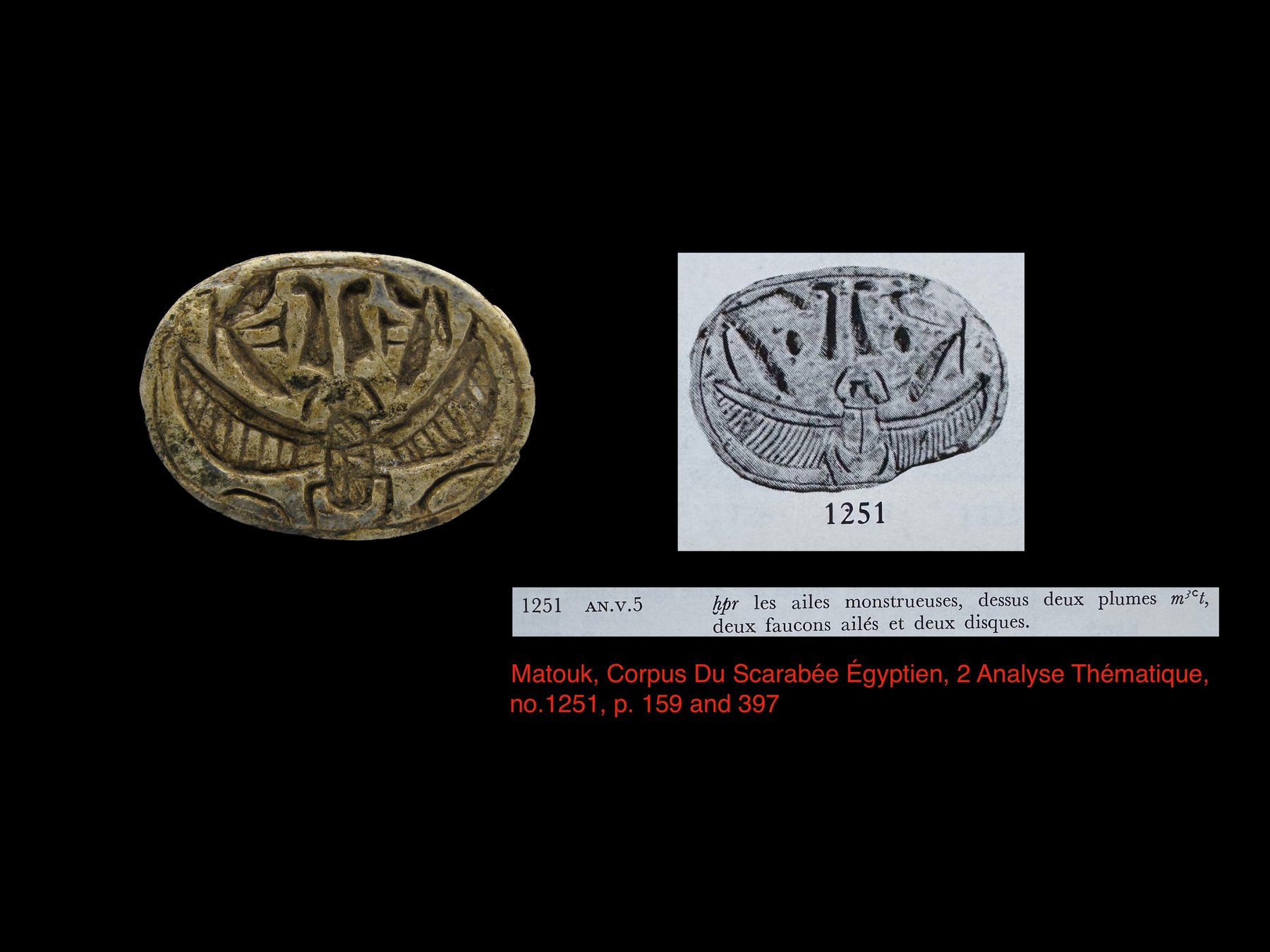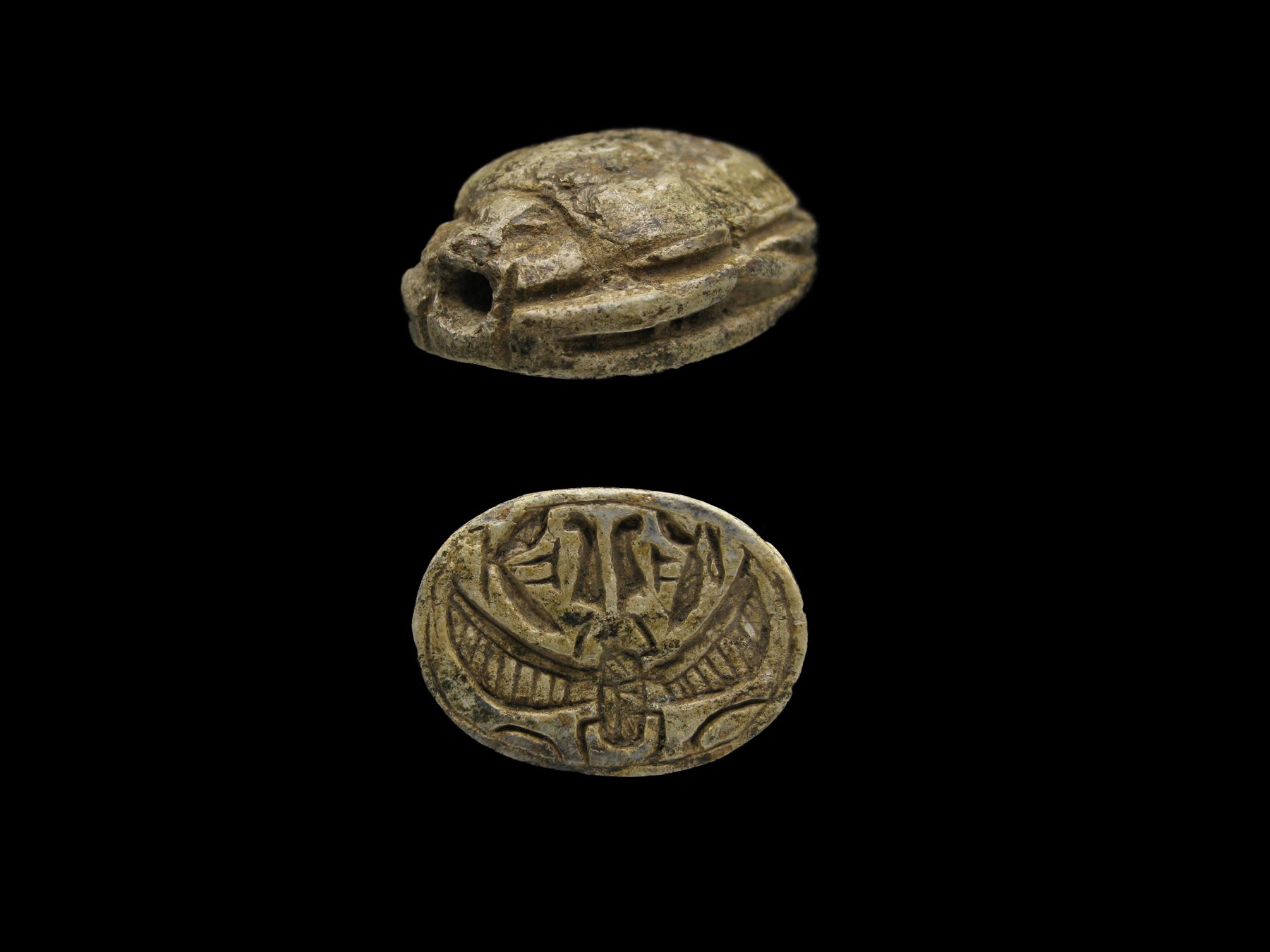
A large steatite scarab tentatively attributed to the Late Period (possibly c. 664–332 BC) based on specialist stylistic assessment, measuring approximately 3.0 cm. The base is engraved with a composition centred on the winged Kheper, the scarab beetle as solar deity and symbol of resurrection and transformation in Egyptian religious tradition.
Specialist assessment suggests the cutting is not particularly refined and may indicate a later production date, possibly as late as the Late Period. The iconographic type — winged Kheper with Maat feathers and flanking falcons — is well attested across multiple periods of Egyptian scarab production and cannot by itself be used to establish a precise date.
The composition is arranged around the central winged Kheper motif: above the head of the Kheper, two Maat feathers rise symmetrically, flanked on either side by falcons with outstretched wings. This arrangement is commonly associated with solar and cosmic symbolism in Egyptian religious imagery, with reference to the sun god's daily renewal with the principles of divine truth and the protective power of Horus. The piece shows ancient wear and minor chipping consistent with genuine use and age, with The piece shows wear and minor chipping consistent with age.
Um grande escaravelho em esteatite atribuído provisoriamente ao Período Tardio (possivelmente c. 664–332 a.C.) com base em avaliação estilística especializada, medindo aproximadamente 3,0 cm. A base está gravada com uma composição centrada no Kheper alado, o escaravelho como divindade solar e símbolo de ressurreição e transformação na tradição religiosa egípcia.
A avaliação especializada sugere que a gravação não é particularmente refinada e pode indicar uma data de produção mais tardia, possivelmente até ao Período Tardio. O tipo iconográfico — Kheper alado com plumas de Maat e falcões flanqueantes — está bem atestado em múltiplos períodos da produção de escaravelhos egípcios e não pode por si só ser utilizado para estabelecer uma data precisa.
A composição está organizada em torno do motivo central do Kheper alado: acima da cabeça do Kheper, duas plumas de Maat erguem-se simetricamente, ladeadas de cada lado por falcões com asas estendidas. Este arranjo é comummente associado ao simbolismo solar e cósmico na imagética religiosa egípcia, com referência à renovação diária do deus sol com os princípios da verdade divina e o poder protector de Hórus. A peça apresenta desgaste antigo e pequenos lascados consistentes com uso e idade genuínos, sem sinais de intervenção moderna.
The winged Kheper scarab is an iconographic type attested across a long span of Egyptian history, from the New Kingdom through the Late Period and Ptolemaic Period. The image of the scarab beetle rolling its ball across the desert was understood as a reflection of the sun's journey across the sky, and the scarab deity Kheper was associated with the morning sun and the concept of becoming and self-creation. The Maat feathers and flanking falcons visible in this composition are common elements of apotropaic and solar religious imagery.
Larger scarabs provided a broader surface for engraved compositions, although size alone does not indicate status or precise function. The iconographic programme here is consistent with a range of production periods and cannot be precisely dated on typological grounds alone.
O escaravelho Kheper alado é um tipo iconográfico atestado ao longo de um longo período da história egípcia, desde o Novo Império até ao Período Tardio e Período Ptolemaico. A imagem do escaravelho a rolar a sua bola pelo deserto era entendida como reflexo da jornada do sol pelo céu, e a divindade escaravelho Kheper estava associada ao sol da manhã e ao conceito de devir e auto-criação. As plumas de Maat e os falcões flanqueantes visíveis nesta composição são elementos comuns da imagética religiosa apotropaica e solar.
Escaravelhos maiores forneciam uma superfície mais ampla para composições gravadas, embora o tamanho por si só não indique estatuto ou função precisa. O programa iconográfico aqui é consistente com um conjunto de períodos de produção e não pode ser datado com precisão apenas com base em critérios tipológicos.
A nearly identical scarab is catalogued in the definitive scholarly corpus of Egyptian scarabs. The composition of this piece corresponds exactly to catalogue number 1251, classified under the typology of winged scarabs with four legs (Scarabées ailés à quatre pattes).
Um escaravelho quase idêntico está catalogado no corpus académico definitivo de escaravelhos egípcios. A composição desta peça corresponde exactamente ao número de catálogo 1251, classificado sob a tipologia de escaravelhos alados com quatro patas (Scarabées ailés à quatre pattes).