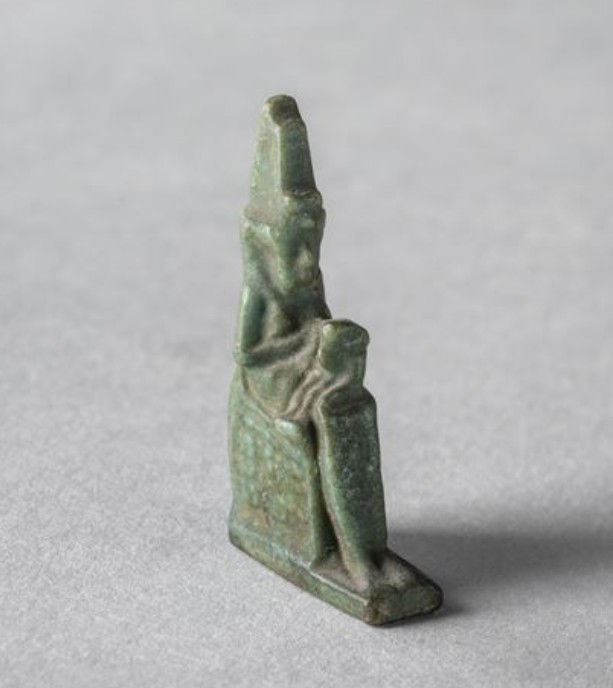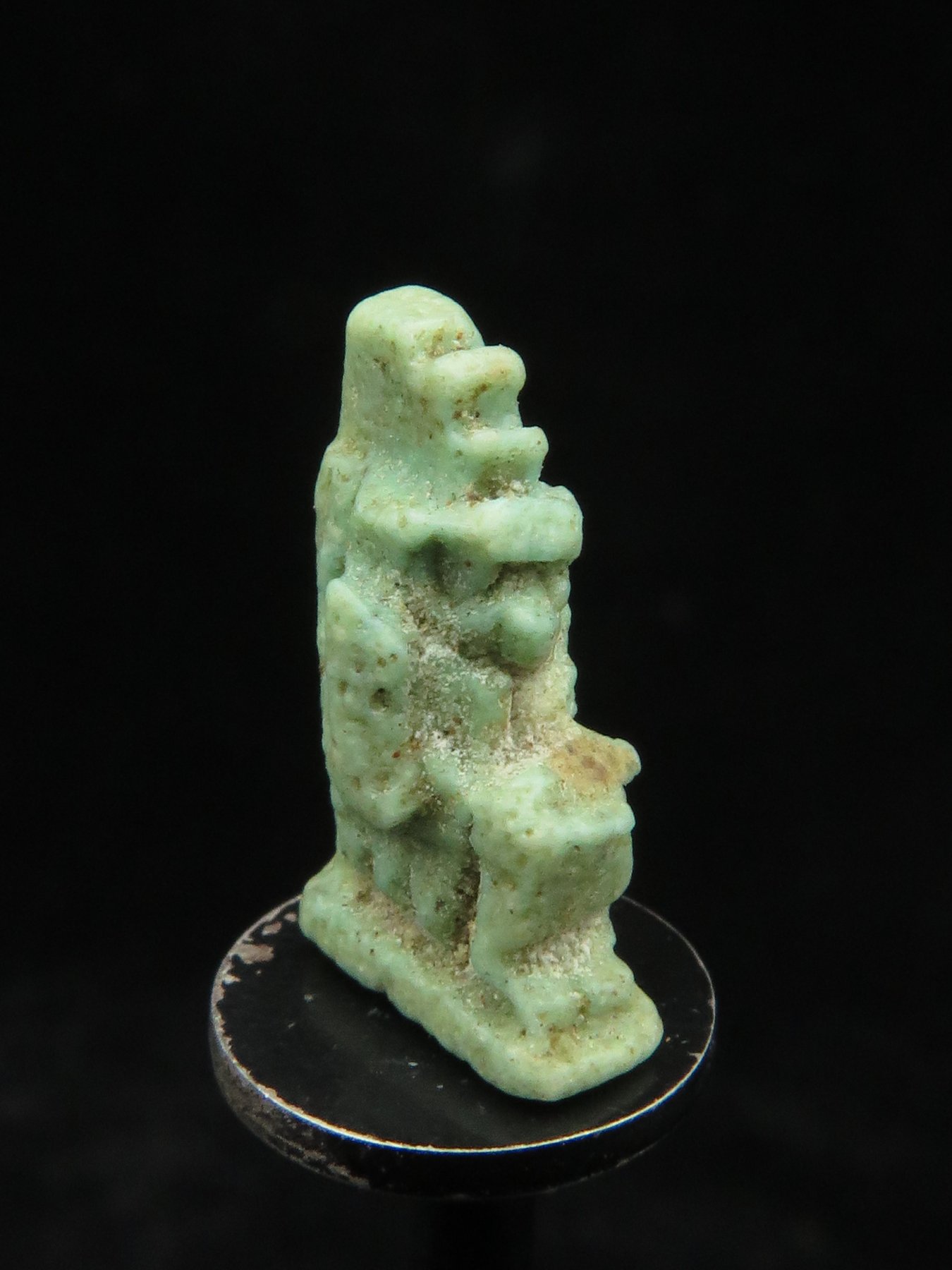
A miniature faience amulet depicting the goddess Isis seated on a throne, nursing the infant Horus on her lap — an iconographic type known as Isis lactans. The figure is modelled in the round with a pale turquoise-green glaze characteristic of Late Period faience production. Despite its diminutive size (1.5 cm), the composition is clear and well-defined: Isis is shown with a high dorsal support, her arms cradling the child Horus who sits upright on her knees.
The back of the piece carries a vertical suspension hole, indicating the amulet was intended to be worn as a pendant. The glaze retains strong colour with minor earthen deposits in the recesses, consistent with burial context.
Um amuleto miniatura em faiança representando a deusa Ísis sentada num trono, a amamentar o bebé Hórus no seu colo — um tipo iconográfico conhecido como Isis lactans. A figura é modelada em bulto redondo com um esmalte verde-turquesa pálido, característico da produção de faiança do Período Tardio. Apesar das suas dimensões reduzidas (1,5 cm), a composição é clara e bem definida: Ísis é mostrada com um alto suporte dorsal, com os braços a amparar o bebé Hórus, que está sentado erecto sobre os seus joelhos.
A parte posterior da peça tem um orifício de suspensão vertical, indicando que o amuleto estava destinado a ser usado como pendente. O esmalte conserva uma cor intensa, com pequenos depósitos terrosos nas reentrâncias, consistentes com contexto de enterramento.
Isis was one of the major goddesses of the Egyptian pantheon — wife of Osiris, mother of Horus, and a powerful magician. When Osiris was murdered and dismembered by his brother Seth, Isis used her magical powers to reassemble his body and conceive Horus posthumously. Fearing Seth's wrath, she hid the infant Horus in the papyrus marshes of the Nile Delta, where he was raised in secret. Horus eventually avenged his father by defeating Seth, restoring order to the cosmos.
The image of Isis nursing Horus became one of the most enduring religious symbols of the ancient world, paralleled in early Christian iconography of the Virgin Mary nursing the infant Christ. Amulets of this type were produced in enormous quantities throughout the Late Period and Ptolemaic era, worn by both the living and the dead for protection and divine favour.
Ísis era uma das principais deusas do panteão egípcio — esposa de Osíris, mãe de Hórus e poderosa maga. Quando Osíris foi assassinado e esquartejado pelo seu irmão Seth, Ísis usou os seus poderes mágicos para reconstituir o corpo e conceber Hórus postumamente. Temendo a fúria de Seth, escondeu o bebé Hórus nos pântanos de papiro do Delta do Nilo, onde foi criado em segredo. Hórus acabou por vingar o pai ao derrotar Seth, restaurando a ordem no cosmos.
A imagem de Ísis a amamentar Hórus tornou-se um dos símbolos religiosos mais duradouros do mundo antigo, com paralelos na iconografia cristã primitiva da Virgem Maria a amamentar o Menino Jesus. Amuletos deste tipo foram produzidos em enormes quantidades ao longo do Período Tardio e da era ptolomaica, usados pelos vivos e pelos mortos para protecção e favor divino.
A comparable example of the Isis lactans iconographic type (Cat. 179, faience, Late Period, 722–332 BC) is held in the permanent collection of the Museo Egizio, Turin.
Um exemplo comparável do tipo iconográfico de Ísis lactans (Cat. 179, faiança, Período Tardio, 722–332 a.C.) encontra-se na colecção permanente do Museo Egizio, Turim.