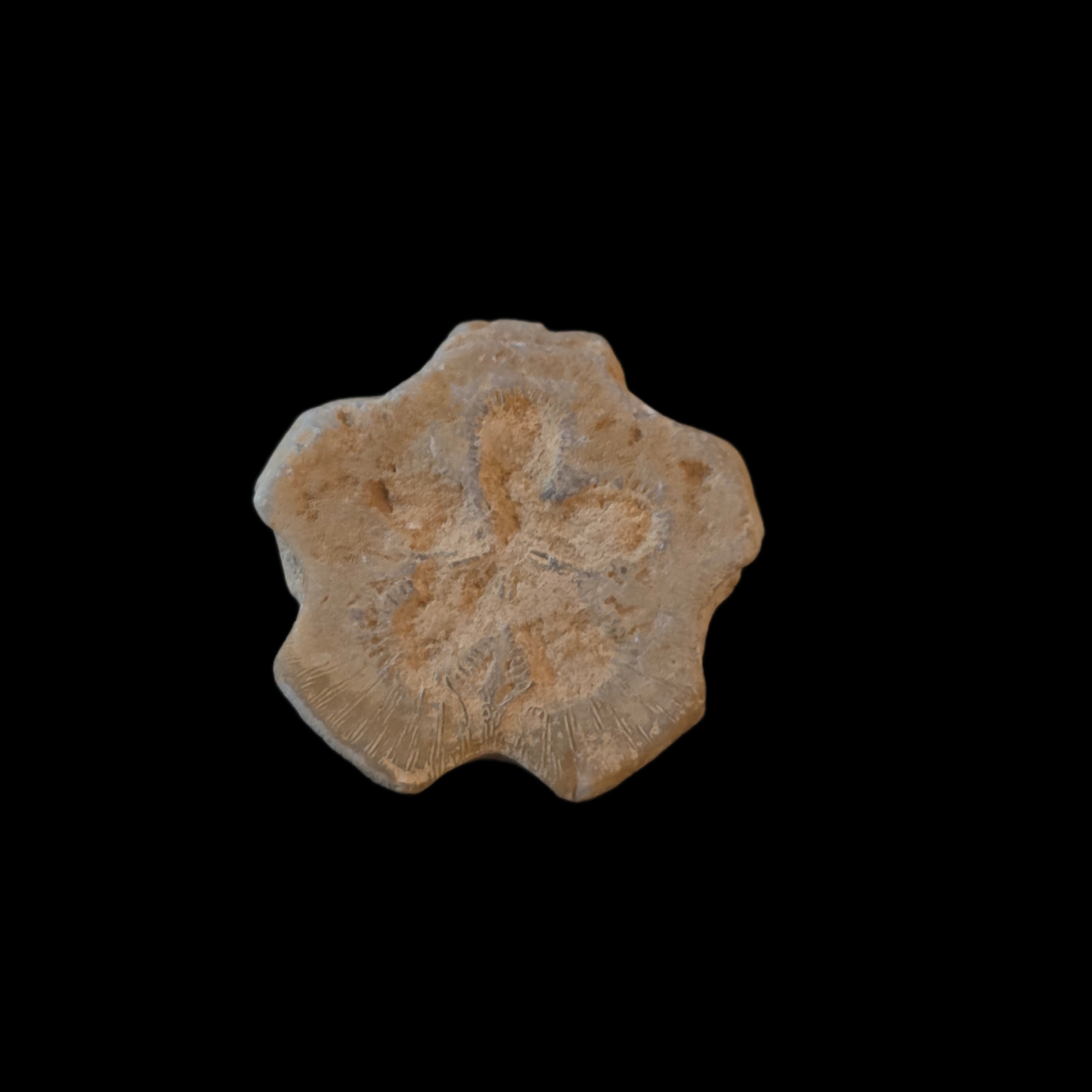
A small steatite decorative element in the form of a stylised five-petalled flower, carved in relief. The motif is present on both sides of the object.
Such objects were probably employed as decorative inlays for furniture, wooden boxes, or other ornamental fittings. The piece displays slight earthy encrustations and surface wear consistent with prolonged burial and age.
Floral motifs played an important role in Egyptian decorative arts throughout many historical periods. Comparable floral elements are known from a variety of decorative contexts in Ancient Egypt.
Pequeno elemento decorativo em esteatite representando uma flor estilizada de cinco pétalas, esculpida em relevo. O motivo está presente em ambas as faces do objeto.
Este tipo de objeto terá provavelmente sido utilizado como incrustação decorativa em mobiliário, caixas de madeira, ou outros elementos ornamentais. O exemplar apresenta ligeiras incrustações terrosas e sinais de desgaste compatíveis com a antiguidade e deposição prolongada.
Os motivos florais desempenharam um papel importante na arte decorativa egípcia ao longo de vários períodos históricos. Elementos florais comparáveis são conhecidos numa variedade de contextos decorativos no Egito Antigo.
Floral motifs remained popular throughout much of Egyptian history and continued to be employed during the Late and Ptolemaic Periods, reflecting the enduring Egyptian preference for plant-inspired decorative forms. A precise date cannot be established in the absence of archaeological context.
The precise botanical identification of this motif remains uncertain, although similar stylised flowers are generally interpreted as conventional decorative designs rather than exact representations of specific species.
Os motivos florais mantiveram-se populares ao longo de boa parte da história egípcia, continuando a ser empregados durante o Período Tardio e Ptolemaico, refletindo a duradoura preferência egípcia por formas decorativas inspiradas em plantas. Uma datação precisa não pode ser estabelecida na ausência de contexto arqueológico.
Embora a identificação botânica exata deste motivo permaneça incerta, flores estilizadas semelhantes são frequentemente interpretadas como representações convencionais utilizadas sobretudo para fins ornamentais.
Published parallels for five-petalled carved steatite floral discs of this type have proved elusive. The closest broadly analogous objects are Egyptian faience rosette discs, which share the general concept of a circular floral element but differ substantially: the standard faience "daisy" rosettes typically have eight petals rather than five, are made in faience rather than steatite, and are generally produced by moulding rather than carving. The typological distance between those parallels and this piece should therefore be noted. The links below illustrate the faience rosette tradition as background context; they do not constitute close comparanda for this object.
Os paralelos publicados para discos florais em esteatite esculpida de cinco pétalas deste tipo revelaram-se difíceis de encontrar. Os objetos mais aproximadamente análogos são os discos de roseta em faiança egípcia, que partilham o conceito geral de um elemento floral circular, mas diferem substancialmente: as rosetas em faiança do tipo "margarida" têm tipicamente oito pétalas em vez de cinco, são produzidas em faiança e não em esteatite, e são geralmente moldadas em vez de esculpidas. A distância tipológica entre esses paralelos e esta peça deve, portanto, ser assinalada. Os links abaixo ilustram a tradição das rosetas em faiança como contexto de fundo; não constituem comparanda próximos desta peça.